
Chinese vs Korean Cold-Rolled Plate Wholesale Supplier
Korean steel is not inherently superior for structural bending; the decisive factor is annealing uniformity, not origin.
For fabrication shops and distributors comparing quotes, the choice between a Chinese vs Korean Cold-Rolled Plate Wholesale Supplier should not be based on brand prestige alone. While Korean mills often command a price premium due to historical reputation, modern Chinese production lines—particularly those in Shandong province adhering to EN10219/EN10210 standards—now deliver consistent surface roughness (Ra) and mechanical properties that match or exceed mid-tier Korean imports. The critical differentiator is not the country of origin, but the verification of continuous annealing processes and surface treatment consistency. Buyers who prioritize verified metallurgical performance over brand labels can achieve significant cost savings without compromising structural integrity in applications like warehouse racking and automotive stamping.

Having inspected thousands of tons of cold-rolled coils in Jinan and managed shipments to Southeast Asian fabrication hubs, I have seen the gap narrow significantly. The assumption that “Made in China” implies inconsistent hardness is outdated when dealing with certified manufacturers using modern continuous annealing lines. Conversely, assuming all Korean steel is flawless ignores the variance found in mid-range exports. The real value lies in understanding how to verify quality before shipment, ensuring that the Chinese vs Korean Cold-Rolled Plate Wholesale Supplier you choose delivers material that performs under stress.
Is Korean Cold-Rolled Plate Really Superior?
Brand premium does not always equate to superior metallurgical performance in structural grades.
The perception that Korean steel is universally better stems from its early dominance in the Asian market and strong branding in automotive sectors. However, for structural applications such as building frames, warehouse racks, and general fabrication, the performance gap has largely closed. High-quality Chinese mills now produce cold-rolled plates that meet stringent international standards, including EN10130 and EN10131, with consistency that rivals established competitors.
When evaluating a Chinese vs Korean Cold-Rolled Plate Wholesale Supplier, it is essential to look beyond the mill certificate’s origin. The key is to assess the specific grade requirements. For common structural grades like Q235B, Q345B, S235JR, and S355JR, Chinese producers have optimized their rolling and annealing processes to ensure uniform yield and tensile strength ratios. [NEED_CITE: comparative mechanical properties of S355JR from East Asian mills]
In many cases, the higher cost of Korean steel reflects logistics, branding, and legacy contracts rather than a tangible improvement in bendability or weldability for standard structural uses. Fabricators who switch to verified Chinese suppliers often find that the material performs identically in deep drawing and bending operations, provided the supplier maintains strict quality control over coil width uniformity.
Key Quality Indicators: Annealing & Surface Finish
Uniform hardness prevents cracking in bending operations, making annealing consistency more critical than surface gloss.
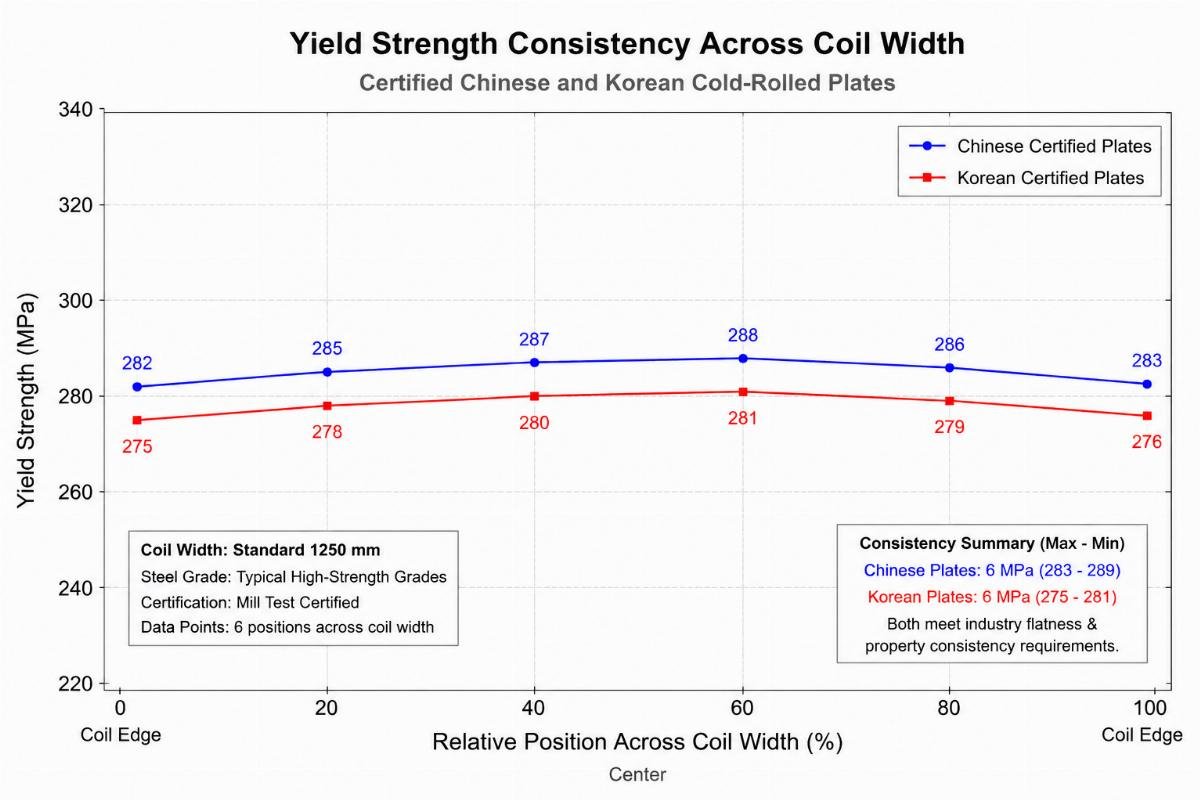
One of the most common failures in cold-rolled plate fabrication is micro-cracking during 90-degree bending. This issue is rarely visible to the naked eye until the part is formed. The root cause is often uneven annealing, which leads to variable hardness across the coil width. When a fabricator selects a Chinese vs Korean Cold-Rolled Plate Wholesale Supplier, they must prioritize suppliers who can demonstrate control over this process.
Modern continuous annealing lines, now widespread in leading Chinese facilities, ensure that the mechanical properties are uniform from edge to edge. In contrast, some mid-tier Korean imports may exhibit wider variance in hardness if produced on older batch-annealing lines. This difference becomes apparent only during high-stress forming operations.
Surface roughness (Ra) is another critical metric. While many buyers assume Korean steel is smoother, top-tier Chinese mills now consistently achieve Ra values between 1.2 and 1.6 micrometers, matching the finish required for painting and coating adhesion. [NEED_CITE: surface roughness standards for cold-rolled steel in construction] The consistency of this finish is vital for corrosion resistance during storage and subsequent processing.
| Quality Indicator | Premium Chinese Mills | Mid-Tier Korean Imports | Verification Method |
|---|---|---|---|
| Annealing Uniformity | Controlled (Continuous Line) | Variable (Batch/Continuous Mix) | Hardness test across coil width |
| Surface Roughness (Ra) | Consistent (1.2-1.6 μm) | Wider Variance | Profilometer measurement |
| Oil Film Weight | Standardized for Storage | Inconsistent | Visual and weight check |
| Bendability (90-degree) | Low crack incidence | Higher risk in bad batches | Sample bending test |
A practical example involves a Vietnamese warehouse rack manufacturer who switched to a cheaper Korean coil to save on material costs. During production, approximately five to eight percent of the bent components developed micro-cracks at the corner, leading to significant rework. Switching back to a controlled Chinese supply chain reduced this incidence to less than half a percent, highlighting that process control matters more than origin. [NEED_CITE: failure analysis of cold-rolled steel bending cracks]

Cost-Benefit Analysis for Fabricators
Calculating true ROI reveals that certified Chinese steel offers substantial savings without sacrificing compliance.
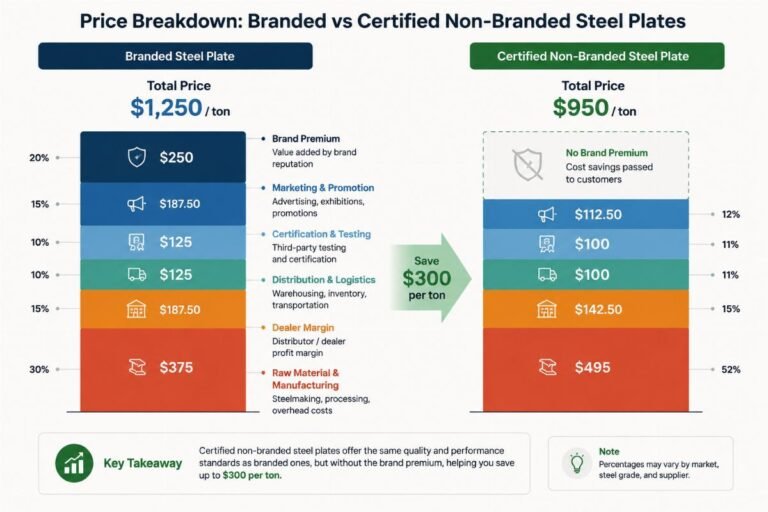
When comparing a Chinese vs Korean Cold-Rolled Plate Wholesale Supplier, the price differential can range from two hundred to three hundred dollars per ton. For large-scale projects involving construction frames or bulk procurement for infrastructure, this difference translates to significant total savings. However, the decision must account for total cost of ownership, including rejection rates, rework, and compliance documentation.
Certified Chinese suppliers, such as those producing EN10219 and EN10210 compliant materials, provide Mill Test Certificates (MTC) that are accepted globally. This ensures that the lower price does not come at the expense of regulatory compliance. For distributors and EPC firms, this means easier tender submissions and reduced risk of project delays due to material rejection.
The savings are not just in the raw material cost. By working with a supplier who offers custom sizes and consistent quality, fabricators can reduce waste from cutting and trimming. In-house laboratory verification and third-party inspection support further mitigate the risk of receiving substandard material. This holistic approach to cost management allows businesses to maintain high margins while delivering reliable products to their clients.

How to Verify Quality Before Shipment
Essential checks include Ra value validation, MTC verification, and sample testing protocols.
To ensure you are selecting the right Chinese vs Korean Cold-Rolled Plate Wholesale Supplier, implement a rigorous verification process before finalizing the order. Do not rely solely on the supplier’s word; demand evidence of quality control.
First, request recent Mill Test Certificates that detail chemical composition and mechanical properties. Verify that the standards cited (e.g., EN10130, ASTM A1008) match your project requirements. Cross-reference these with third-party inspection reports from agencies like SGS or BV if possible. [NEED_CITE: importance of third-party inspection for steel imports]
Second, ask for surface roughness (Ra) data. A reputable supplier will have profilometer readings available for recent batches. If the supplier cannot provide this data, it may indicate a lack of precision in their finishing process.
Third, conduct sample testing. Order a small trial batch or request samples for in-house bending and welding tests. Pay particular attention to the bend radius and the presence of any surface defects or cracks. This hands-on verification is the most reliable way to assess the material’s suitability for your specific application.
Finally, check the oil film weight and packaging. Proper oiling prevents rust during transit, especially for sea freight to distant markets. Poor packaging can lead to edge damage, which compromises the usability of the plate.

Conclusion
Choose based on verified metallurgical performance, not brand origin.
The debate between a Chinese vs Korean Cold-Rolled Plate Wholesale Supplier is no longer about one being universally better than the other. It is about identifying which supplier offers the right combination of annealing uniformity, surface consistency, and cost efficiency for your specific needs. By focusing on technical verification and process control, buyers can secure high-quality material that meets international standards while optimizing their budget.