

Chinese Steel Plate vs Baowu POSCO: Buyer Cost Analysis
The brand name on the steel plate is rarely the primary driver of structural integrity.
For most infrastructure and fabrication projects in the Middle East and Africa, certified Chinese steel plates offer identical metallurgical performance to premium brands like Baowu or POSCO. The perceived cost difference is largely a brand premium rather than a quality differential. True cost efficiency is achieved by analyzing total landed cost—including certification compliance, logistics optimization, and documentation accuracy—rather than focusing solely on ex-works price tags.
I still remember the heat radiating off the rebar stacks in Riyadh last summer. A general contractor pointed at our quotation for Q345B medium plates and asked, “What is the actual difference between this and Baowu? The price gap is significant. How can I trust you?” Beside him, a POSCO distributor smiled silently, letting the brand halo do the work. That moment clarified a recurring issue in global steel procurement. Buyers often compare logos instead of material properties. In my years navigating the Gulf markets, I have seen projects overrun budgets because buyers paid for a label they did not need, while others faced delays due to poor documentation from cheaper, uncertified sources. The key is not choosing between “Chinese” and “Branded,” but understanding what you are actually paying for. [NEED_CITE: brand premium impact on industrial material pricing]

To make an informed decision, we must dissect the components that drive value. This analysis breaks down the real cost structure behind Chinese Steel Plate vs Baowu POSCO Cost Analysis, helping you validate whether lower-priced alternatives meet your project compliance requirements without compromising budget or safety.
Why Do Baowu and POSCO Command a Premium?
Brand equity often masks identical metallurgical performance in standard structural grades.
When buyers request Baowu or POSCO plates, they are frequently purchasing insurance against risk rather than superior physical properties. For standard grades like S355JR or Q345B, the chemical composition and mechanical properties are defined by international standards such as EN 10025 or GB/T 1591. Any mill producing to these standards must meet the same yield strength, tensile strength, and impact energy requirements. [NEED_CITE: mechanical property requirements for EN 10025 S355JR]
The premium charged by top-tier brands covers their extensive R&D, global marketing, and stringent internal quality control systems. However, for many applications, this level of oversight exceeds the technical necessities of the project. A certified Chinese manufacturer with in-house laboratory capabilities can produce plates that meet the exact same EN or ASTM specifications. The difference lies in the consistency of documentation and the reputation of the mill, not necessarily the steel itself.
Consider a warehouse fabrication project in Dubai. A distributor compared Baowu plates against those from a specialized Chinese mill like Xin Jiyuan. The surface treatment quality, specifically shot blasting to Sa2.5 standards, was identical. Yet, the Baowu plates carried a noticeable price premium simply due to the brand label. The buyer paid for the logo, not for better steel. [NEED_CITE: case study on brand premium in construction materials]

Understanding this dynamic allows buyers to shift focus from brand recognition to verification. If a Chinese supplier can provide third-party inspection reports and valid Mill Test Certificates (MTCs), the material is technically equivalent for most structural uses. This realization is the first step in conducting a meaningful Chinese Steel Plate vs Baowu POSCO Cost Analysis.
The Hidden Costs of “Cheap” Chinese Plates
Low ex-works prices often hide significant risks in documentation and dimensional consistency.
The stereotype that “Chinese steel” equals low quality is outdated. The real issue is inconsistent certification documentation. Many low-cost suppliers cut corners on paperwork, leading to customs delays or rejection by project consultants. In one instance, a buyer saved on material costs by switching to a non-certified Chinese supplier for a Riyadh infrastructure project. However, the shipment arrived with incomplete MTCs, causing a multi-week delay while documents were rectified. The savings were erased by storage fees and project penalties. [NEED_CITE: impact of documentation errors on construction project timelines]
Another hidden cost is dimensional tolerance. Cheaper mills may produce plates with wider thickness variations. While this might seem minor, it affects welding procedures and structural calculations. If a plate is thinner than specified, engineers may require additional reinforcement, increasing labor and material costs downstream. Conversely, thicker plates mean paying for unused steel weight.
Buyers often compare ex-works prices without accounting for these risks. A slightly higher price from a reputable manufacturer like Xin Jiyuan, which maintains strict in-house laboratory controls and offers EN10219/EN10210 certified production lines, can prevent costly downstream issues. The key is to verify the supplier’s ability to provide consistent dimensions and complete, accurate documentation before shipment.
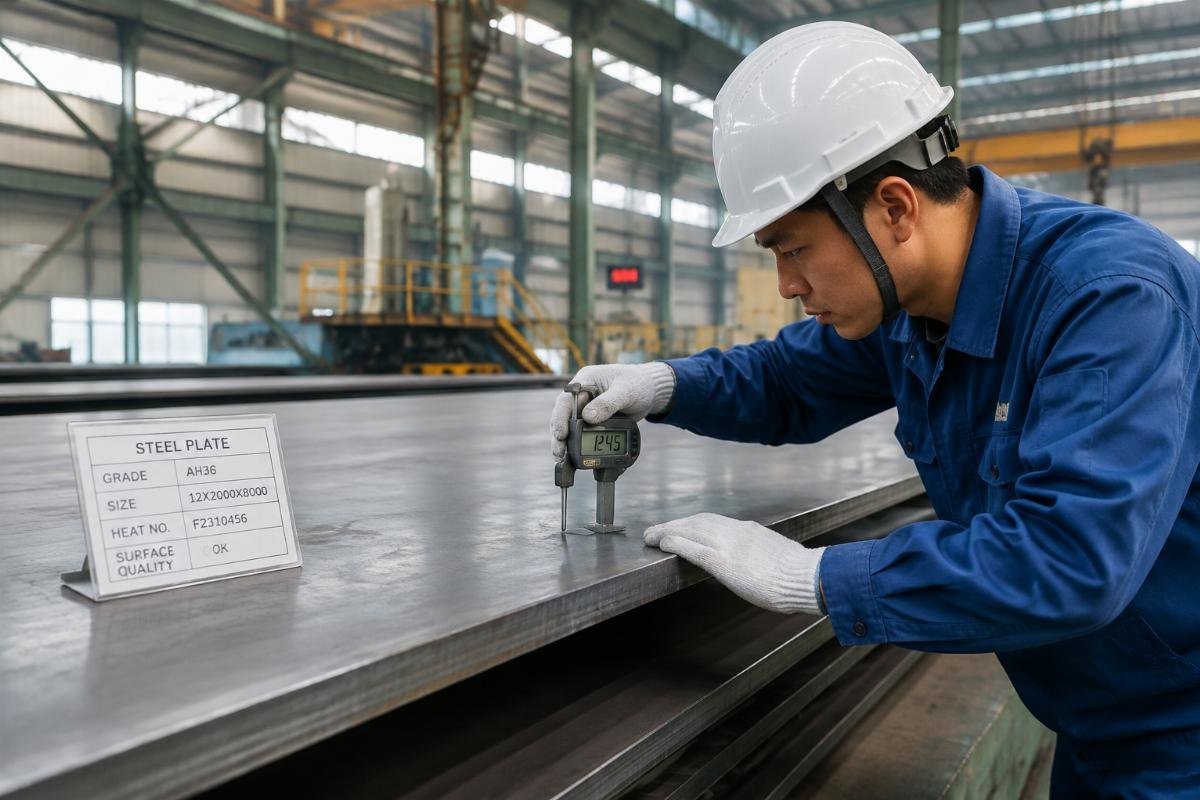
This highlights why a superficial price comparison is misleading. When performing a Chinese Steel Plate vs Baowu POSCO Cost Analysis, you must factor in the risk premium associated with documentation reliability and dimensional accuracy. A supplier with a proven track record of export compliance reduces this risk, offering better value even if the unit price is higher than the lowest bidder.
Head-to-Head: Q345B/S355JR Performance & Certification
Metallurgical equivalence is established through standard compliance, not brand origin.
For buyers in the Middle East and Africa, the choice often comes down to Q345B (Chinese standard) versus S355JR (European standard). These grades are largely interchangeable for structural applications. Q345B corresponds closely to S355JR in terms of yield strength and chemical composition. [NEED_CITE: cross-reference table for Q345B and S355JR steel grades]
The critical factor is certification. Projects funded by international bodies or requiring strict compliance often mandate EN 10210 or EN 10219 certification. Many Chinese mills produce to GB standards only, which may not be accepted without additional third-party verification. Suppliers like Xin Jiyuan, however, maintain production lines specifically certified for EN standards, bridging this gap.
| Feature | Premium Brands (Baowu/POSCO) | Certified Chinese Mills (e.g., Xin Jiyuan) | Non-Certified Low-Cost Mills |
|---|---|---|---|
| Metallurgical Performance | High Consistency | High Consistency | Variable |
| Certification Availability | Full EN/ASTM/GB | EN/ASTM/GB Available | GB Only / Self-Declared |
| Documentation Accuracy | Excellent | Good to Excellent | Poor / Risk of Errors |
| Dimensional Tolerance | Tight | Standard to Tight | Wide / Inconsistent |
| Price Level | High | Moderate | Low |
An African bridge tender once rejected non-branded plates due to a lack of EN10210 certification. The contractor had to switch to a certified Chinese mill that could provide third-party inspection reports from agencies like SGS or BV. This incident underscores that certification is a decision factor, not just price. [NEED_CITE: importance of EN certification in international tenders]

By choosing a certified Chinese manufacturer, buyers can access material that meets the same technical standards as premium brands. This allows for a more accurate Chinese Steel Plate vs Baowu POSCO Cost Analysis, where the comparison is based on verified compliance rather than assumed quality.
Calculating True Landed Cost: A Buyer’s Matrix
Real savings come from optimizing total landed cost, not just unit price.
Ex-works price is only one component of the total cost. Freight, insurance, customs duties, handling fees, and risk premiums all contribute to the final landed cost. Buyers who focus solely on the unit price often overlook opportunities for savings in logistics and customs clearance.
For example, optimizing container loading can significantly reduce freight costs per ton. Specialized manufacturers often offer custom cutting services, allowing buyers to order plates in sizes that maximize container utilization. Additionally, accurate HS coding and complete documentation can speed up customs clearance, reducing port storage fees and demurrage charges. [NEED_CITE: logistics cost optimization in steel importation]
A buyer in the Middle East might find that a Chinese plate with a slightly higher ex-works price results in a lower total landed cost due to better packaging, efficient loading, and faster customs processing. In contrast, a cheaper plate from a less experienced supplier might incur higher logistics costs due to poor packing or documentation errors.
| Cost Component | Impact on Total Landed Cost | Optimization Strategy |
|---|---|---|
| Ex-Works Price | Direct | Compare certified suppliers |
| Freight | Significant | Optimize container loading |
| Customs & Duties | Variable | Ensure accurate HS coding |
| Handling & Storage | Moderate | Fast clearance via complete docs |
| Risk Premium | Hidden | Choose suppliers with proven compliance |
This holistic view is essential for a realistic Chinese Steel Plate vs Baowu POSCO Cost Analysis. It shifts the focus from the sticker price to the total project budget, revealing where true efficiencies lie.

How to Verify Quality Without the Brand Name
Third-party inspections and mill audits replace brand trust with verifiable data.
Without a famous logo, how do you ensure quality? The answer lies in rigorous verification. Requesting third-party inspection reports from recognized agencies like SGS, Bureau Veritas, or Lloyd’s Register provides objective evidence of quality. These reports cover chemical composition, mechanical properties, and dimensional checks.
Visiting the manufacturer’s facility, either physically or via virtual audit, allows buyers to assess production capabilities and quality control processes. Look for in-house laboratories equipped with modern testing instruments. Suppliers like Xin Jiyuan, with over two decades of export experience and multiple international certifications, demonstrate this commitment to transparency. [NEED_CITE: role of third-party inspection in steel quality assurance]
Additionally, check for specific certifications relevant to your project, such as EN10219 for structural hollow sections or EN10210 for hot-finished sections. Ask for sample MTCs from previous shipments to verify the clarity and completeness of their documentation.

By implementing these verification steps, buyers can confidently source from certified Chinese manufacturers. This approach mitigates risk and ensures that the Chinese Steel Plate vs Baowu POSCO Cost Analysis reflects true value rather than brand perception.
Conclusion
Cost efficiency in steel procurement is driven by verification, not branding.
Stop comparing logos and start comparing certificates. Certified Chinese steel plates offer a viable, cost-effective alternative to premium brands for most structural applications. By focusing on total landed cost, ensuring proper certification, and verifying quality through third-party inspections, buyers can achieve significant savings without compromising project integrity. The key is to look beyond the ex-works price and understand the full value chain.


