
S355JR Steel Plate Manufacturer & Supplier for European Buyers
S355JR is not just a grade; it is a compliance trap if thickness tolerances and impact temperatures are ignored.
True compliance for S355JR steel plate specifications requires strict adherence to EN10025-2 standards, specifically managing negative thickness tolerances within Class B limits per EN10029 and verifying mandatory +20°C impact energy values. Most import rejections occur not due to chemical composition errors, but because mill certificates fail to explicitly confirm these mechanical properties under the correct testing conditions.
I still remember the humidity in the inspection bay at Jebel Ali Port. The air was thick with salt and diesel fumes. A client from Dubai stood over a stack of S355JR plates, a digital caliper in hand, his face growing darker with every measurement. He wasn’t checking the yield strength; he was measuring thickness. Every single plate hovered at the very bottom of the allowable negative tolerance. Technically, they were within the broad standard. Practically, they were useless for his structural framework because the cumulative deviation exceeded his fabrication tolerance stack-up. We had to pay for local grinding and third-party re-certification. That loss taught me that for European and Middle Eastern buyers, the paper certificate is only half the battle. The physical reality of the steel must match the engineering intent. [NEED_CITE: common causes of structural steel rejection at EU ports]
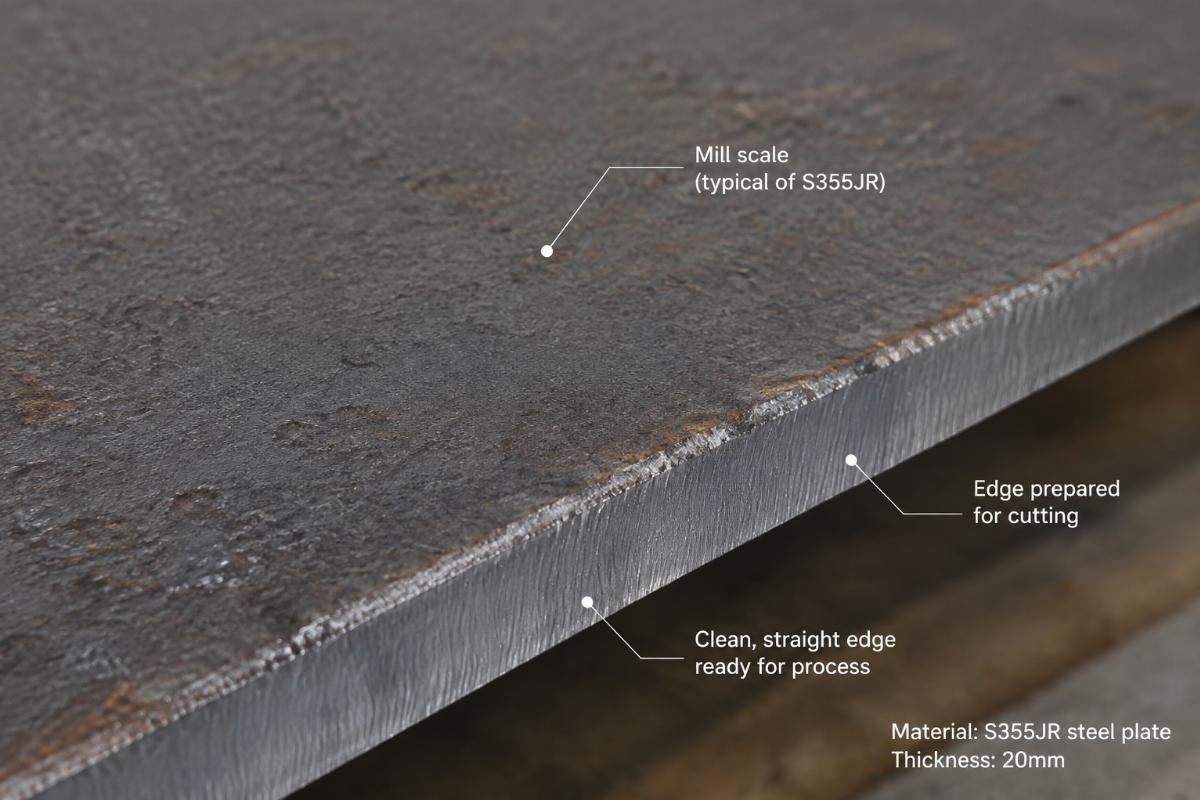
This guide breaks down the technical nuances that separate a smooth customs clearance from a costly dispute. It focuses on the specific pitfalls of S355JR steel plate specifications, moving beyond basic chemistry to the mechanical realities that matter on the construction site.
What Defines True S355JR Compliance Beyond the Name?
The grade name S355JR guarantees nothing about performance if the thickness exceeds 40mm without proper rolling control.
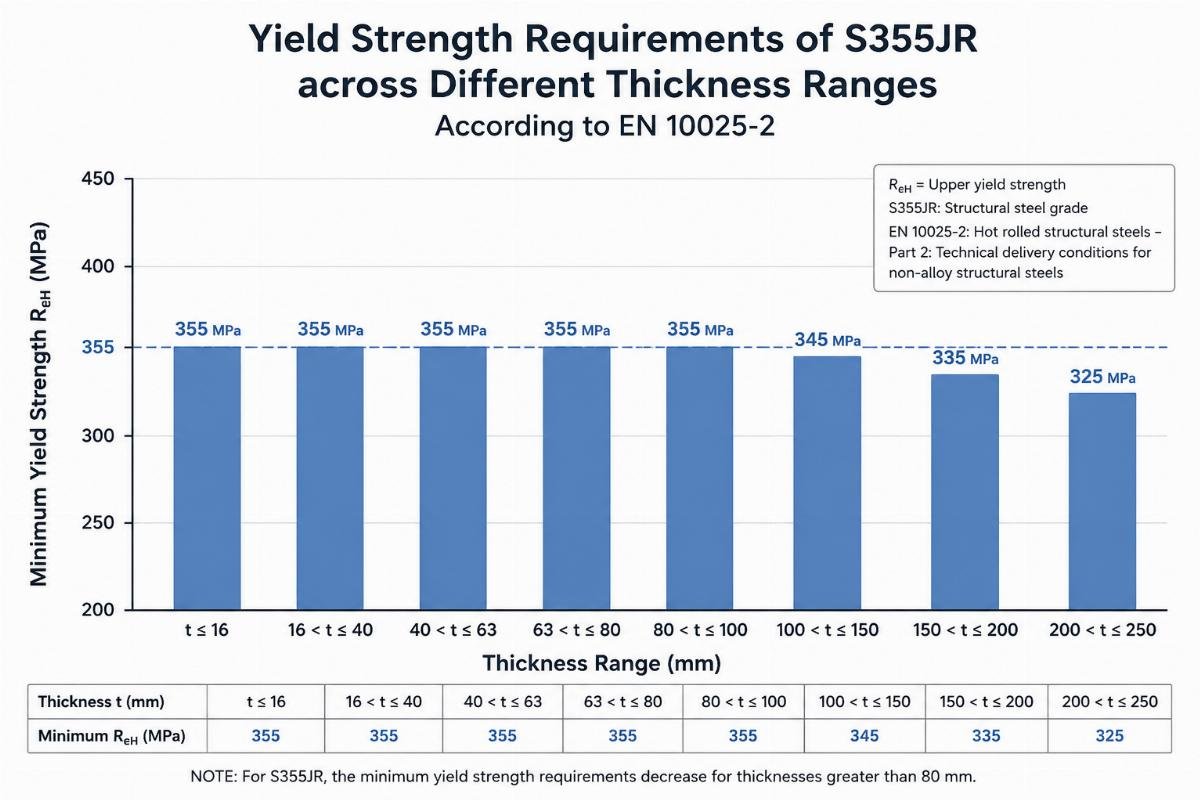
Many procurement managers assume that “S355” means a yield strength of 355 MPa regardless of the plate’s dimensions. This is a dangerous misconception. According to EN10025-2, the yield strength requirement decreases as the thickness increases. For plates up to 16mm, the minimum yield is 355 MPa. However, for thicknesses between 40mm and 63mm, this requirement drops significantly. If your structural design relies on the full 355 MPa value for a thick base plate, you must verify the actual tested yield strength on the Mill Test Certificate (MTC), not just the grade name.
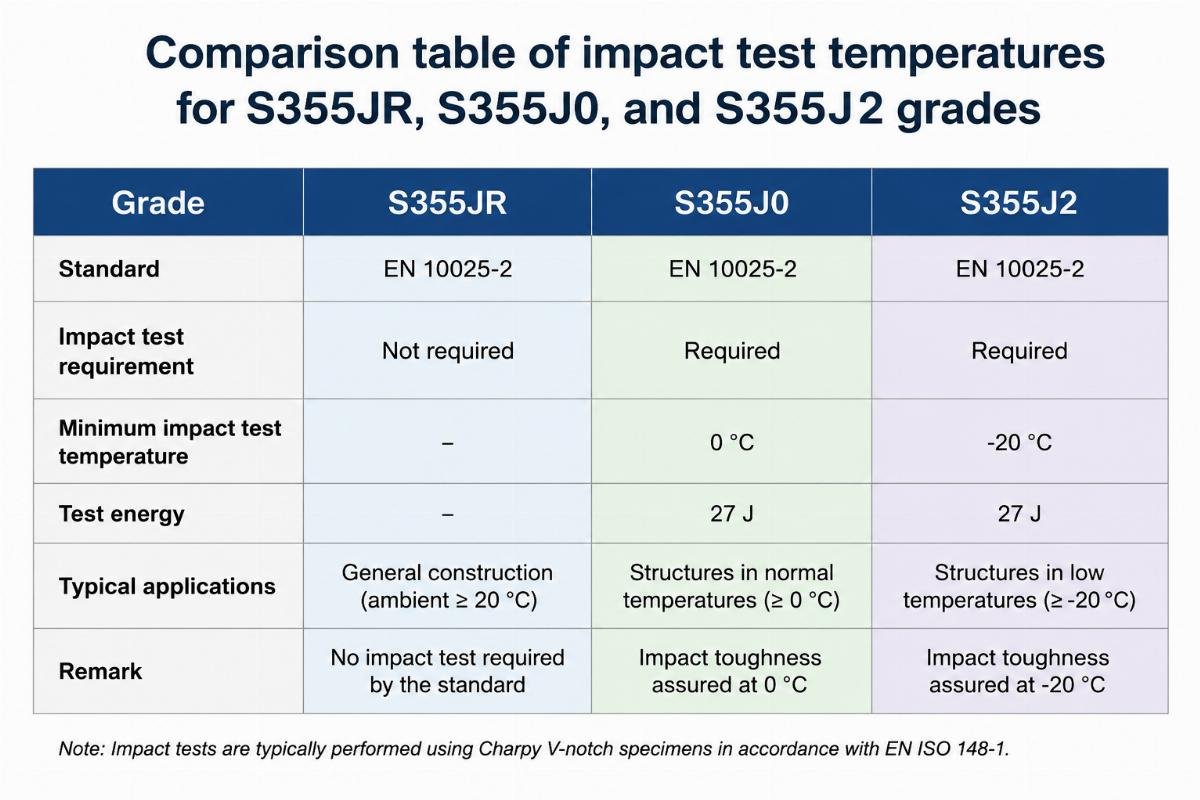
Furthermore, the “JR” suffix is often overlooked. It denotes the impact energy requirement at +20°C. While this seems mild compared to J0 (-20°C) or J2 (-40°C), it is mandatory. A plate that meets the tensile strength but fails the Charpy V-notch impact test at room temperature is non-compliant. I have seen MTCs where the impact test column was left blank or marked “N/A” because the thickness was below the threshold requiring testing. For critical structural nodes, always request verified impact data, even if the standard technically allows an exemption for thin gauges. [NEED_CITE: EN10025-2 mechanical property requirements by thickness]
The chemical composition also plays a subtle role. Carbon equivalent (CEV) values determine weldability. High CEV can lead to cracking during fabrication, especially in colder climates. A compliant S355JR steel plate specifications sheet must show controlled levels of Carbon, Manganese, and Silicon to ensure the CEV remains within weldable limits for your specific application.
Why Do Thickness Tolerances Cause Most EU Import Disputes?
Negative tolerances are not a manufacturing defect; they are a commercial risk that must be managed proactively.
In the steel industry, mills produce to standard tolerance classes, typically Class A or Class B per EN10029. Class B allows for tighter tolerances than Class A. However, many mills aim for the nominal thickness but often land on the negative side to save material costs. For a buyer, receiving plates that are consistently at the lower limit of Class B can cause significant issues during fabrication. If your design assumes a nominal 20mm thickness but you receive 19.1mm plates, your weld volumes change, your bolt fits may loosen, and your structural calculations could be compromised.
A common scenario involves hollow sections made from plate. If the plate thickness is inconsistent, the resulting square or rectangular hollow sections will have varying wall thicknesses, affecting their load-bearing capacity. This is why S355JR steel plate specifications must include a clear agreement on tolerance class. For high-precision projects, specifying Class B or even negotiating a tighter internal tolerance is essential.
I recall a project in Northern Europe where the fabricator rejected an entire shipment because the thickness variation caused alignment issues in a modular bridge component. The plates were technically within EN10029 Class B, but the fabricator’s automated welding robots could not compensate for the variance. The cost of rework far exceeded the savings from buying standard tolerance stock. To avoid this, buyers should request a tolerance report alongside the MTC, showing the actual measured thicknesses of a sample batch. [NEED_CITE: EN10029 thickness tolerance classes for flat products]

How to Verify Mill Certificates for European Projects?
A Mill Test Certificate is not a guarantee of quality; it is a claim that must be cross-referenced with physical marks and independent checks.
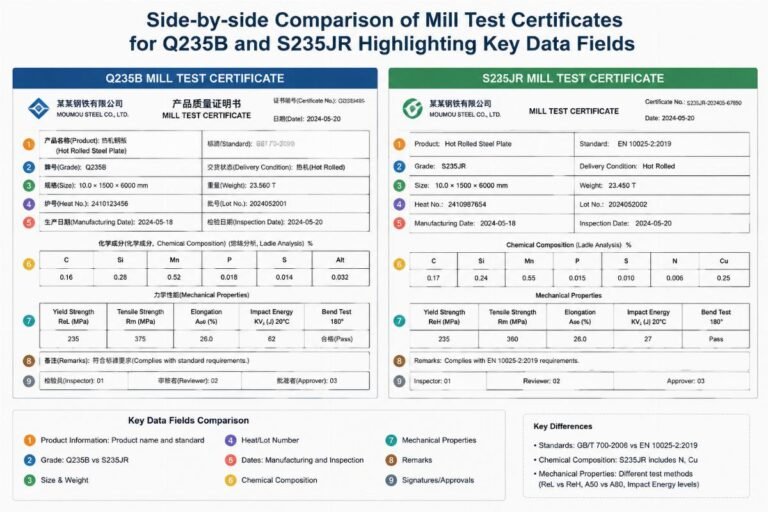
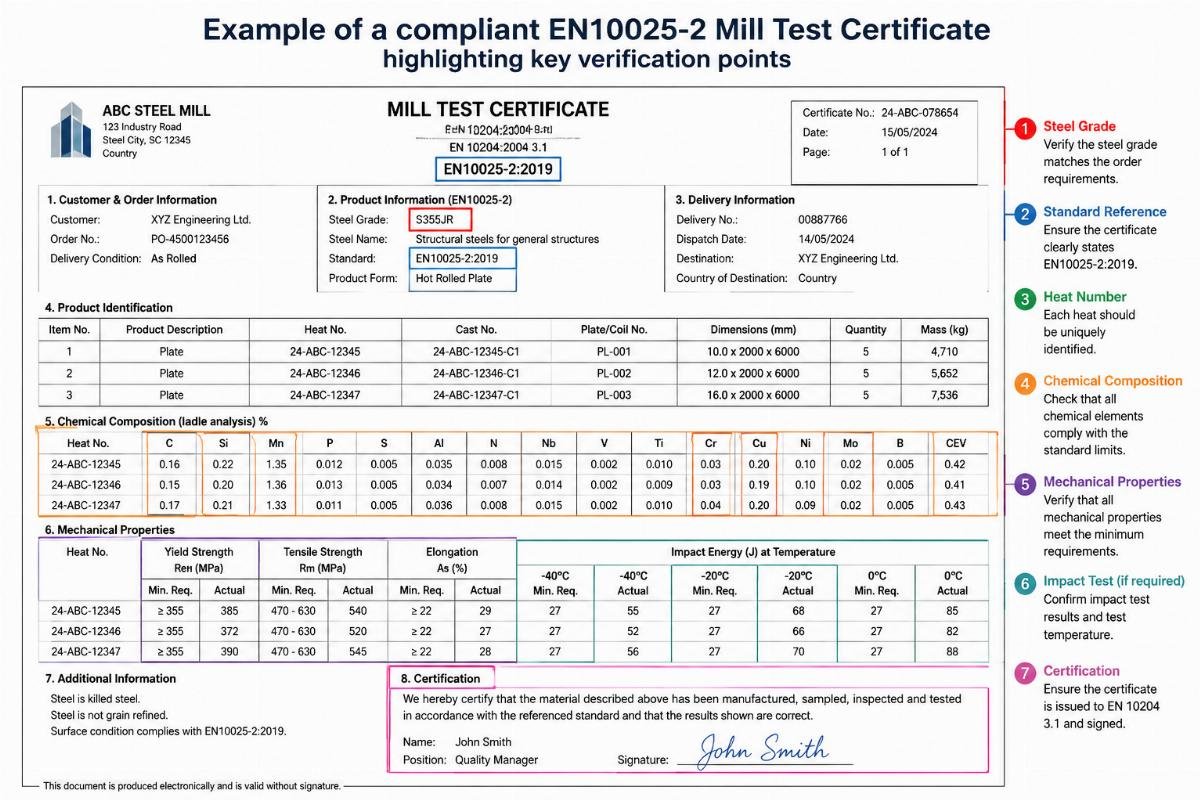
The MTC is the primary document for proving compliance with S355JR steel plate specifications. However, fraud and errors do occur. A genuine MTC must include the heat number, cast number, and specific test results for each batch. It should reference EN10025-2 explicitly. Beware of generic certificates that list average values rather than actual test results for the specific coils or plates you purchased.
Key elements to verify include:
- Heat Number Matching: Ensure the heat number on the MTC matches the stenciled mark on the physical plate.
- Impact Test Temperature: Confirm that the impact energy values are recorded at +20°C for JR grade. If the certificate shows tests at -20°C, it might be mislabeled J0, or if blank, it might be non-compliant for certain applications.
- Chemical Composition: Check that Carbon, Manganese, and Sulfur levels are within the specified limits. High Sulfur can lead to lamellar tearing.
- Mechanical Properties: Verify that Yield Strength, Tensile Strength, and Elongation meet the requirements for the specific thickness range.
For critical projects, such as bridges or offshore structures, relying solely on the mill’s certificate is risky. Many European buyers now require third-party verification by agencies like Bureau Veritas or SGS. These inspectors perform random sampling and re-testing to ensure the MTC data reflects the actual material. In one case, a third-party test revealed that the impact energy of a batch was borderline, despite the MTC showing comfortable pass rates. This discrepancy saved the buyer from potential failure in service. [NEED_CITE: importance of third-party inspection for structural steel imports]
When Should You Choose S355J0 or J2 Over JR?
Temperature is the deciding factor, not just geography.
S355JR is suitable for general structural applications in temperate climates. However, if the structure will be exposed to low temperatures, the toughness of the steel becomes critical. The “JR” designation means the steel is tested for impact resistance at +20°C. If the ambient temperature drops below this, the steel may become brittle and prone to sudden fracture under load.
For projects in Northern Europe, Canada, or high-altitude regions, S355J0 (tested at -20°C) or S355J2 (tested at -40°C) is often required. The choice depends on the lowest expected service temperature. Using S355JR in a cold environment is a violation of most building codes and poses a severe safety risk.
Additionally, thicker plates are more susceptible to brittle fracture due to the constraint effect. Therefore, even in moderate climates, thick sections used in critical load paths may require J0 or J2 grades to ensure adequate toughness. Always consult the project’s engineering specifications to determine the required impact test temperature. Do not assume JR is sufficient just because it is cheaper. The cost difference is negligible compared to the risk of structural failure. [NEED_CITE: selection criteria for steel grades based on service temperature]
Conclusion
Compliance with S355JR steel plate specifications is defined by precise tolerance management and verified mechanical properties, not just the grade name.
Buyers must look beyond the basic chemical composition and focus on thickness tolerances per EN10029 and impact energy values at the correct temperature. Rigorous verification of Mill Test Certificates and consideration of third-party inspections are essential for avoiding costly disputes and ensuring structural integrity. By understanding these technical details, procurement managers can secure materials that truly meet the demands of their European and global projects.