
Steel Coil HS Code: Q235B/Q345B Wholesale Supplier for Global Import
Material grade does not determine the HS code; physical dimensions do.
The correct Steel Coil HS Code Classification for hot-rolled coils like Q235B or Q345B is primarily driven by width (specifically whether it exceeds 600mm), thickness, and surface treatment, rather than the chemical composition alone. Most standard wide hot-rolled steel coils fall under heading 7208, while narrow strips or alloy-specific flat products may shift to 7211 or 7225, drastically altering import duty liabilities.
I learned this distinction the hard way during a shipment to Ho Chi Minh City. The commercial invoice listed “Q345B Hot Rolled Steel Coil,” and the local broker automatically filed it under a general structural steel category. At the port, customs officials measured the width at 1250mm but noted the specific alloy content triggered a different regulatory clause in their national tariff schedule. The reclassification from a standard hot-rolled code to an alloy flat-rolled code resulted in an immediate spike in anti-dumping duties. The client was furious, not because of the tax itself, but because the delay halted a critical foundation pour. That incident shifted my entire approach to documentation. Now, every proforma invoice includes a preliminary customs breakdown based on physical specs, not just material grades. [NEED_CITE: WCO Harmonized System explanatory notes for Chapter 72]
Understanding these nuances is essential for any procurement manager aiming to avoid unexpected landed costs. Let’s break down why these codes vary and how to secure the right classification before the vessel leaves Qingdao or Tianjin.
Why Does Steel Coil HS Code Vary by Destination?
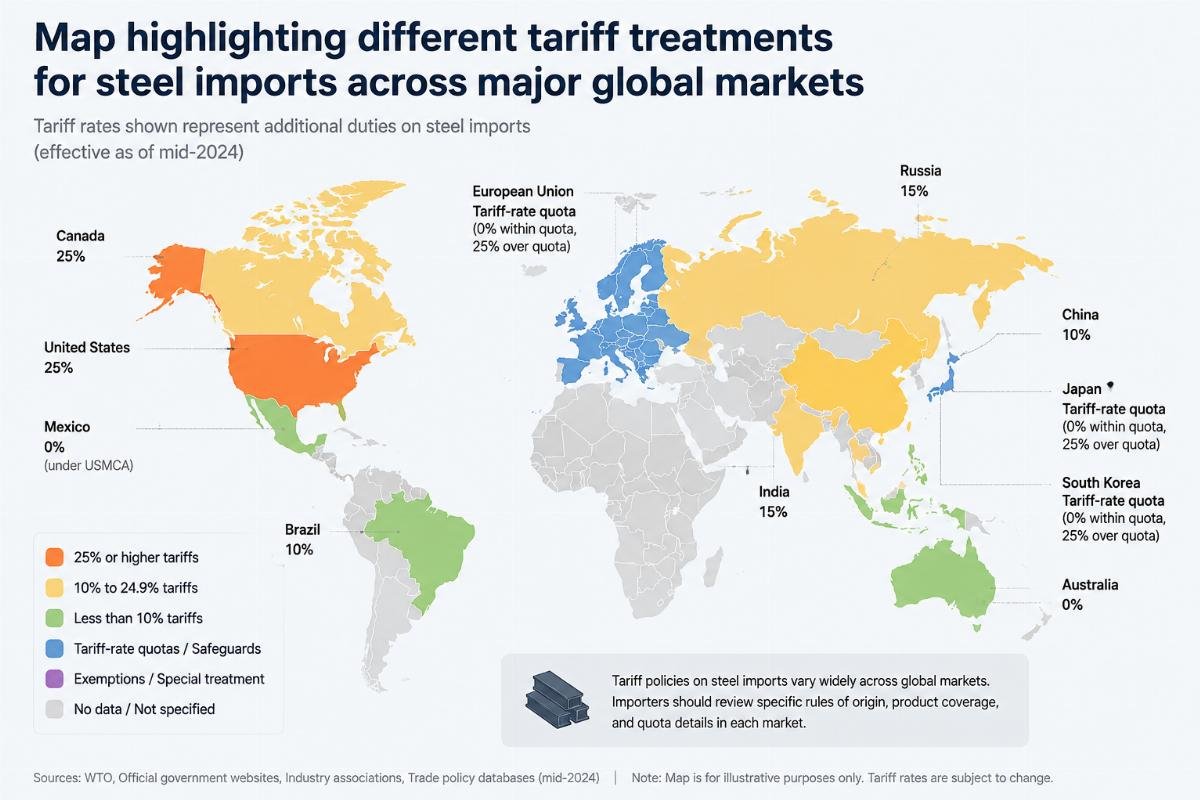
Many buyers assume that a universal code exists for “steel coil.” While the first six digits of the Harmonized System are standardized globally, the subsequent digits—and more importantly, the applied tariffs—are highly localized. A code that attracts zero duty in one Southeast Asian nation might trigger significant safeguards in another.
The variation stems from how different countries protect their domestic steel industries. For instance, some regions impose strict anti-dumping measures on specific types of hot-rolled coils originating from China. If your Steel Coil HS Code Classification is too generic, customs authorities may apply the highest possible duty rate associated with any steel product in that chapter. Conversely, a precise classification that aligns with free trade agreements or specific exclusions can reduce the tax burden significantly.
I once assisted a distributor in the Middle East who was importing S355JR coils for a warehouse project. The initial quote used a broad code that did not specify the cold-rolled nature of the final processing stage. Upon arrival, the local authority argued that the product should be classified as a higher-value finished good rather than a raw material, leading to a VAT recovery dispute. By providing detailed mill certificates that explicitly stated the rolling method and dimensional tolerances, we were able to prove the product fit the lower-duty raw material category. [NEED_CITE: International Chamber of Commerce guidelines on customs valuation]
This highlights a critical point: customs officers look for consistency between the physical goods and the declared code. If the description says “coil” but the code implies “sheet,” or if the width suggests “strip” but the code says “wide,” discrepancies arise. These discrepancies are not merely administrative errors; they are red flags for potential duty evasion.
Key Parameters That Determine Your Steel Coil’s HS Code
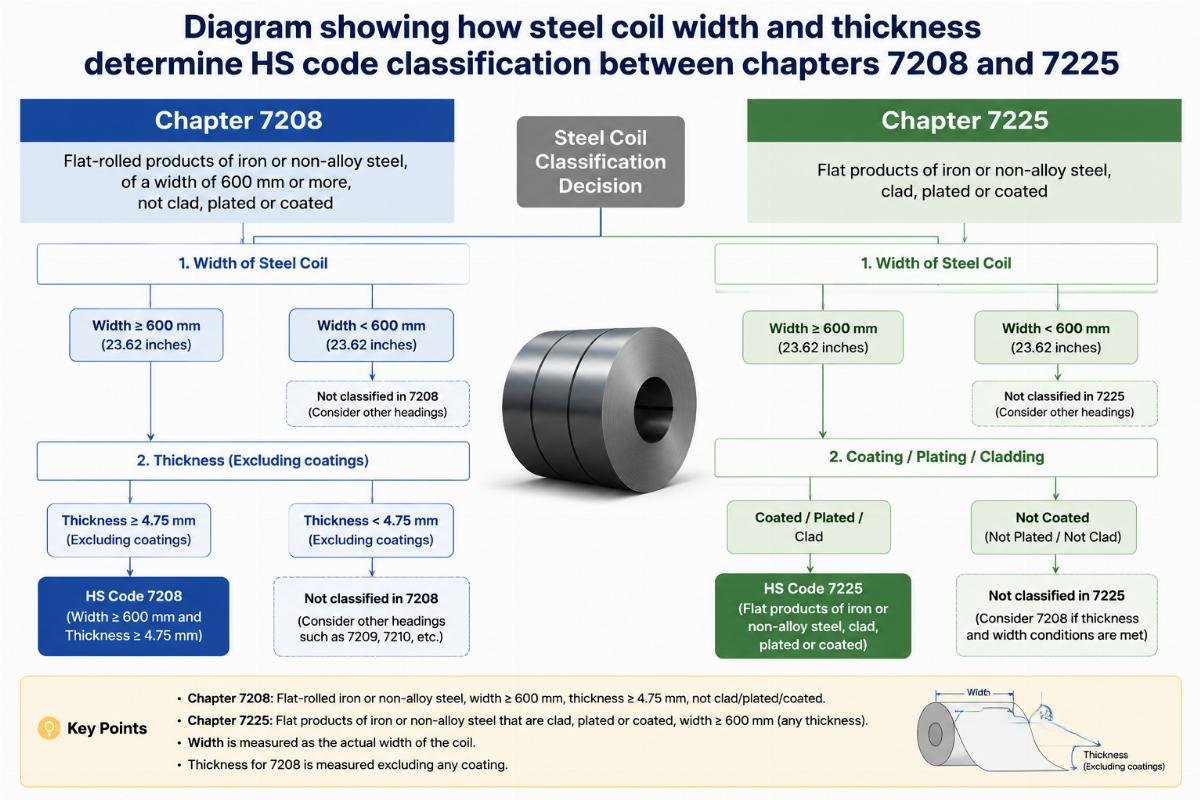
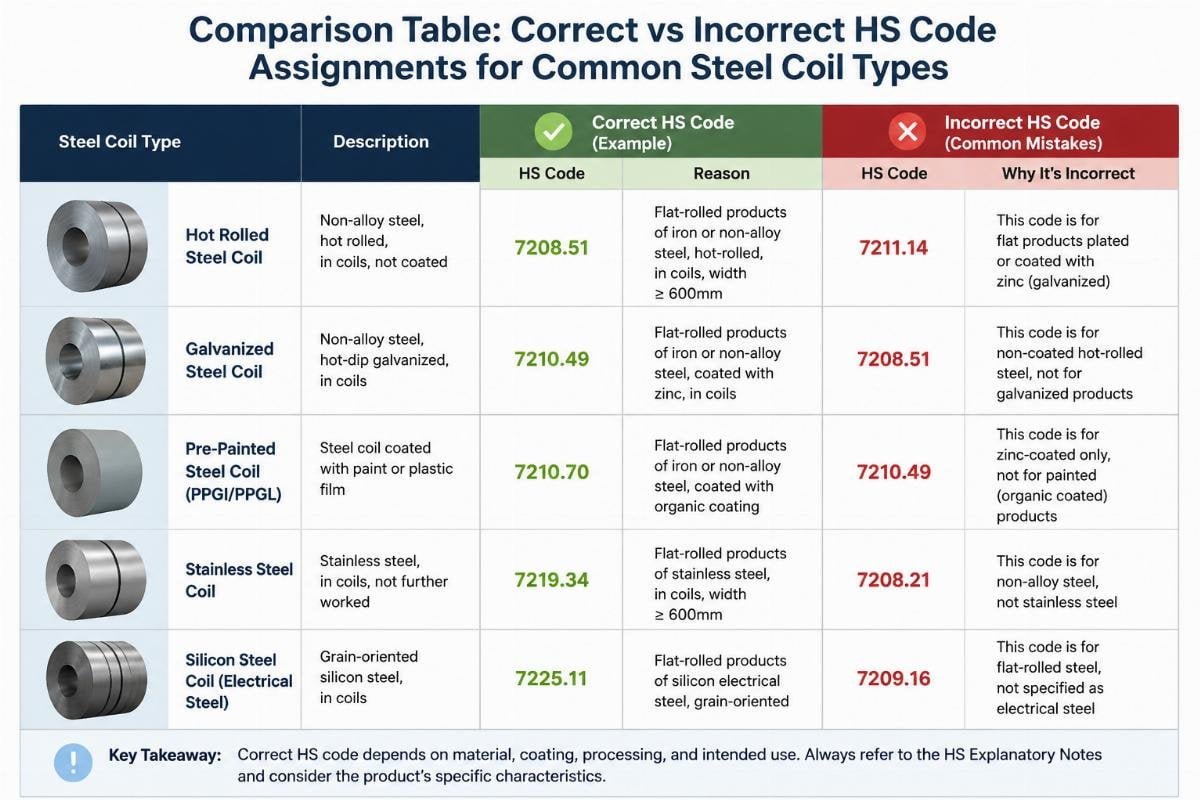
To navigate the complex web of tariffs, you must focus on three physical parameters: width, thickness, and coating. These factors dictate whether your product falls under heading 7208 (hot-rolled, wide), 7209 (cold-rolled, wide), or other specialized headings.
Width is the primary divider. In the Harmonized System, flat-rolled products with a width of 600mm or more are generally classified differently from those under 600mm. A Q235B coil with a width of 1500mm will almost certainly fall under the 7208 series if it is hot-rolled. However, if that same material is slit down to 400mm, it moves into the “narrow strip” categories, such as 7211 or 7212. This shift is not trivial; narrow strips often face different quota restrictions.
Thickness also plays a role, particularly in distinguishing between plate-like coils and thinner sheet products. While the HS system does not always have a hard cutoff for thickness in the same way it does for width, local tariff schedules often use thickness to determine if a product qualifies for specific industrial exemptions.
Coating is the third critical variable. A bare hot-rolled coil is classified differently from a galvanized or painted one. Adding a zinc coating moves the product into heading 7210 or 7212, depending on the width. This change can be beneficial or detrimental, depending on the destination country’s trade policies regarding value-added steel products.
| Parameter | Impact on HS Code | Common Headings |
|---|---|---|
| Width > 600mm | Classified as “Wide” flat-rolled products | 7208, 7209, 7210 |
| Width < 600mm | Classified as “Narrow” strip | 7211, 7212 |
| Hot-Rolled | Base classification for uncoated wide coils | 7208 |
| Cold-Rolled | Higher value classification for uncoated wide coils | 7209 |
| Galvanized/Coated | Moves to coated product headings | 7210, 7212 |
| Alloy Content (e.g., Q345B) | May shift to alloy-specific headings if other elements exceed thresholds | 7225, 7226 |
[NEED_CITE: World Customs Organization Harmonized System Nomenclature for Chapter 72]
When sourcing from a Steel Coil HS Code Classification expert, ensure they provide these exact specifications in the packing list. Ambiguity here is the root cause of most clearance delays.
Common Misclassifications and Their Costly Consequences
Misclassification is rarely an accident; it is often a result of oversimplification. Buyers tend to rely on the material grade, such as Q235B or Q345B, assuming it defines the product. However, customs systems are built around physical form and processing history.
A frequent error involves confusing hot-rolled and cold-rolled codes. While both are flat-rolled, cold-rolled products undergo additional processing, which increases their value and often their duty rate. Declaring a cold-rolled coil as hot-rolled to save on duties is considered fraud and can lead to severe penalties, including blacklisting.
Another common pitfall is ignoring the impact of alloying elements. Standard carbon steels like Q235B usually stay within the 7208-7210 range. However, high-strength low-alloy steels like Q345B or S355JR can sometimes trigger classification under heading 7225 if the specific alloy content meets certain criteria defined by local customs. This was the case with the Vietnam shipment mentioned earlier. The client assumed Q345B was just “stronger steel,” but the customs authority viewed it as a distinct alloy product subject to different trade remedies.
The financial impact of these errors extends beyond the duty difference. Re-classification at the port leads to storage fees, demurrage charges, and potential fines. In one instance, a European buyer faced a mid-six-figure loss due to delayed clearance caused by a simple code mismatch. The goods sat at the terminal for weeks while experts debated whether the coating thickness qualified it as “lightly coated” or “heavily coated,” each carrying a different tax rate.
To avoid this, always verify the code against the destination country’s specific tariff schedule. Do not rely solely on the supplier’s default code. Ask for a breakdown that explains why a particular code was chosen based on width, thickness, and coating.
How to Verify the Correct Code Before Shipping
Verification is a proactive process that begins before the production order is finalized. It requires collaboration between the buyer, the supplier, and often a local customs broker in the destination country.
First, request a detailed technical data sheet from the manufacturer. This document should include not just the chemical composition, but the exact rolling method, final dimensions, and surface treatment details. For a Steel Coil HS Code Classification, these physical attributes are more important than the grade name.
Second, cross-reference these specifications with the import country’s customs tariff database. Many countries provide online tools where you can input product details to receive a suggested code. While these tools are not legally binding, they offer a strong indication of how local authorities view the product.
Third, consider obtaining a binding ruling or pre-clearance advice if the shipment value is significant. Some customs administrations allow importers to submit product samples and documentation for a formal classification decision before the goods arrive. This eliminates uncertainty and provides legal protection against future re-classification.
In my practice, I ensure that every export package from our Jinan facilities includes a comprehensive set of documents. These include the mill test certificate, which verifies the chemical and mechanical properties, and a detailed packing list that specifies the dimensions of each coil. We also provide a letter of explanation that links the physical specs to the proposed HS code. This transparency helps customs officers make quick, accurate decisions, reducing the risk of inspection delays.
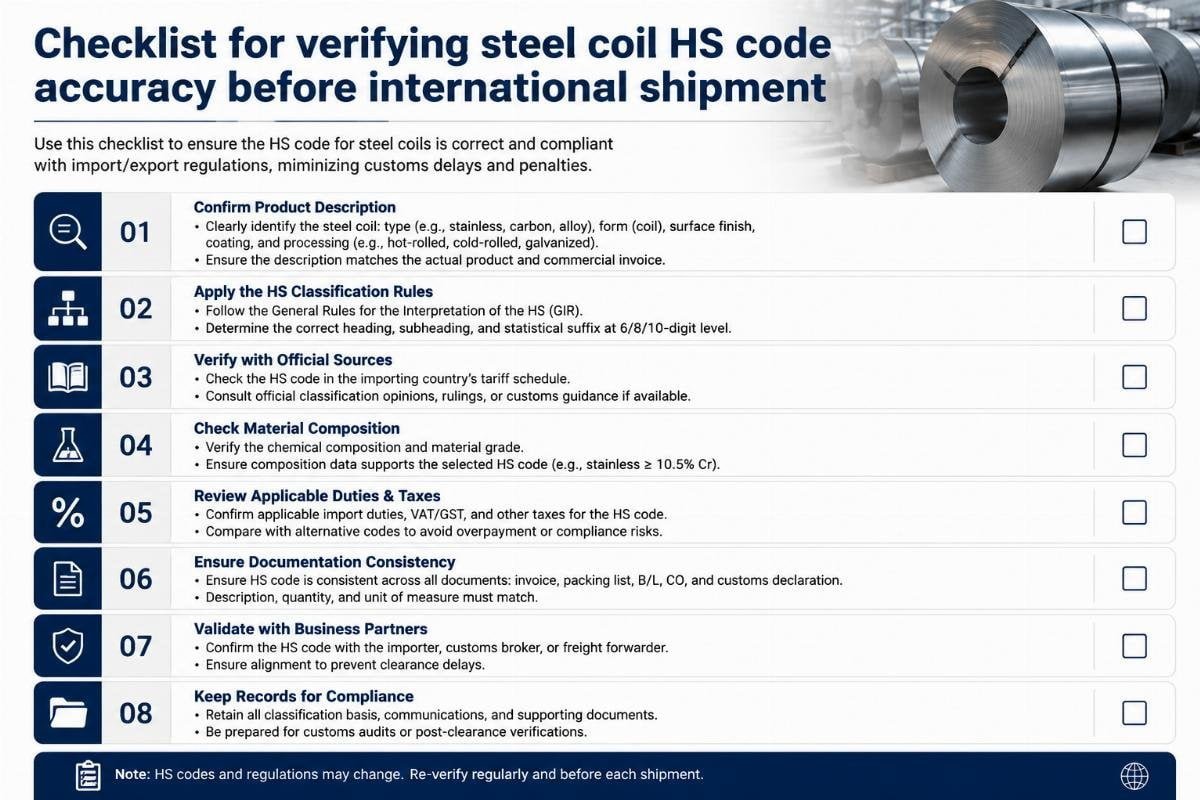
For buyers working with a Steel Coil HS Code Classification specialist, this level of documentation is standard. It reflects a deep understanding of international trade regulations and a commitment to smooth logistics.
Conclusion
Accurate classification prevents costly delays and duty spikes.
Mastering Steel Coil HS Code Classification requires focusing on physical dimensions and processing methods rather than just material grades. By understanding the impact of width, thickness, and coating, and by verifying codes against local tariffs, importers can ensure smoother clearance and predictable landed costs.